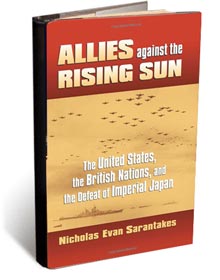
Allies against the Rising Sun

The United States, the British Nations, and the Defeat of Imperial Japan

The role of America’s British allies in the Pacific Theater has been largely ignored. Nicholas Sarantakes now revisits this seldom-studied chapter, offering the most detailed assessment ever published of the U.S. alliance with Great Britain, Australia, New Zealand, and Canada.

Sarantakes examines Britain’s motivations for participating in the invasion of Japan, the roles envisioned by its Commonwealth nations, and the United States’ decision to accept their participation. He shows how maintaining the coalition, even in the face of a number of disputes, served the interests of ever coalition member.

Sarantakes describes how Churchill favored British-led operations to revive the colonial empire, while his generals argued that Britain would be further marginalized if it did not fight alongside the United States in the assault on Japan’s home islands. Commonwealth partners saw an opportunity to support the mother country in service of their own separatist ambitions. And even though the United States called the shots, it welcomed allies to share the predicted casualties of an invasion.

Sarantakes takes readers into the halls of both civil and military power in all five nations to show how policies and actions were debated resolved. He not only describes the participation of major heads of state but also brings in a cast of military leaders including General of the Army Douglas MacArthur and Fleet Admiral Chester Nimitz on the American side and Admiral of the Fleet Sir Andrew Cunningham and Field Marshal Sir Alan Brooke on the British. He also paints vivid scenes of battle, including the attack of the British Pacific Fleet on Japan and ground fighting on Okinawa.

Blending diplomatic, political, and military history encompassing naval, air, and land forces, Sarantakes’s work reveals behind-the-scenes political factors in warfare alliances and explains why the Anglo-America coalition survived World War II when it had collapsed after World War I.

Reviews

Douglas Ford, Journal of the Society for Army Historical Research (Winter 2013) vol. 91, no. 368, 339-340

J. Charles Schiencking, Japanese Studies (May 2013), vol. 33, no. 1, 126-127

Robert J. Thompson, Army History (Summer 2012), 39-40

John L. Miney, Air & Space Power Journal (July-August 2012) vol. 26, no. 4, 165-167

Richard Palimaka, The Canadian Army Journal (2012), vol. 14, no. 3, 134-135

Greg Kennedy, Diplomatic History (November 2011), vol. 35, no. 5, 917-919

John Francis, Northern Mariner (October 2011) vol. 21, no. 4, 439-441

Paul S. Burtness and Warren U. Ober, The Australian Journal of Politics and History (September 2011) vol. 57, no. 3, 473-474

Theresa Kaminski, Canadian Journal of History (Autumn 2011) vol. 46, no. 2, 482-483

A. A. Nofi, StrategyPage.com, April 6, 2011

 “Books,” Ausmarine (March 2011), 34

Gerhard Weinberg, Pacific Historical Review (February 2011) vol. 80, no. 1, 167-169

Christopher Baxter, Journal of Strategic Studies (February 2011) vol. 34, no. 1, 148-151

 “World War II: General,” The NYMAS Review (Winter-Spring 2011), 7-8

Keith Neilson, International Journal (Winter 2010-2011) vol. 66, no. 1, 237-239

Clayton K. S. Chun, Parameters (Autumn 2010), 146-147

Craig C. Felker, Presidential Studies Quarterly (September 2010) vol. 40, no. 3, 580-581

Paul M. McGarr, The International History Review (September 2010), vol. 32, no. 3, 565-566

Doug Bandow, “How the War Partners Got Along,” The Washington Times, July 16, 2010, B4

J. R. Breihan, Choice (August 2010) vol. 47, no. 12, 2387

Mike Oppenheimer, “Tag-Teaming Japan in the Pacific,” Military History (July 2010), 70-72

Robert Reilly, Military Review (May-June 2010), 136

Ashley Jackson, Proceedings (May 2010) vol.136, no. 5, 152

Stanley L. Falk, “Evolution of WWII Strategy,” Army (March 2010), 120-121

Kevin Winter, Sacramento Book Review (February 2010)

Leonardo Panaggio, The Newport Daily News (January 26, 2010), B6

Additional Books